Skull model of a kanglion
This is a model of the skull of a kanglion. The most prominent feature of the bag lion is its large, scissor-like split meat teeth (located on the sides of the upper and lower jaws), and large front, rodent or primate-like incisors, rather than the canines of modern cats. It was not a real lion, but a carnivorous marsupial that lived in Pleistocene Australia. It is the largest carnivorous mammal in Australian history. It has a strong bite force and can hunt prey much larger than its own size.

Grant gazelle skull specimen
The Gazella gazelle, also known as the great gazelle, is a species of gazelle that lives in East Africa and is known for its elegance and speed. Grant's gazelle has a beige to orange fur with a white belly. Shoulder height is about 75-95cm (30-37 inches). Males weigh between 50-80kg (110-180 lb) and females are slightly lighter, weighing about 35-50kg (77-110 lb). Both males and females have horns, but males have more prominent horns, measuring 45-81cm (18-32 in) in length, presenting a parabolic shape with a thicker base.

Sika Deer Skull Specimen
Sika deer (scientific name: Cervus nippon) belongs to the genus Cervidae, with a body length of 140-170cm, a shoulder height of 85-100cm, a tail length of 12-13cm, and a weight of 100-150kg. Males have horns, while females have no horns. The horns of stags are usually divided into 3-4 forks. The sika deer has large, erect ears, slender limbs, a well-proportioned trunk, and a short tail. The fur is red, with multiple rows of irregular white spots along the sides of the spine, the lower jaw is white, the nasal surface and cheeks are sandy yellow, the back of the tail is dark brown, the lower part of the tail and the groin are white, and the abdominal hair is pale brown.

Ezo Deer Skull Specimen
Ezo deer or known as Hokkaido sika deer, is a subspecies of sika deer, mainly found in the Hokkaido region of Japan. Bucks are large in size, weighing more than 200kg in autumn. The length of their horns is usually more than 35 inches (about 0.89 meters), and the longest record is 44 inches (about 1.12 meters). Hokkaido sika deer are social animals, usually in small groups.

High-horned gazelle skull specimen
The high-horned antelope (scientific name: Aepyceros melampus) is a mammal of the cloven-hoofed bovine family high-horned antelope, also known as wide-angle antelope and impala. There are vertical black spots on both sides of the buttocks and black spots on the back heel. The female has no horns; the male's horns are long and harp-like, reaching 0.5-0.8 metres. The average life expectancy is 12 years. The high-horned antelope is distributed in Kenya, Uganda and South Africa in central and southern Africa. Likes to live in grasslands and open woodlands. Usually form a small group of 15-25 live together. In the dry season, small groups will gather together to form large groups of more than a few hundred.

Serval Antelope Skull Specimen
Serval Antelope (scientific name: Tragelaphus scriptus): body length 100-125cm, shoulder height 90cm, weight 45-80kg. Males are slightly larger. Mainly brownish red or yellowish brown. They have distinct vertical markings and the males have long spiral horns. There are 11 subspecies, with different patterns of fur and white streaks and spots on the face, depending on the subspecies with geographically different distribution.

Southern Elephant Seal Skull
The southern elephant seal is a mammal of the elephant seal family. The male beast is 6.5 meters long and weighs 4000 kilograms. The female is slightly smaller, 3.5 meters long and weighs 1000 kilograms. The reproductive male is about four times as large as the female. The body is spindle-shaped, very thick and fat, but the body is soft and can be bent into a U-shape towards the back. The male has a long cockscomb-shaped nose that swells when excited or angry. The body color is silver gray, the old beast is pale brown and yellowish, into a filthy tone, the dorsal side is deeper than the ventral side. The incisors are small and the male canines are large.
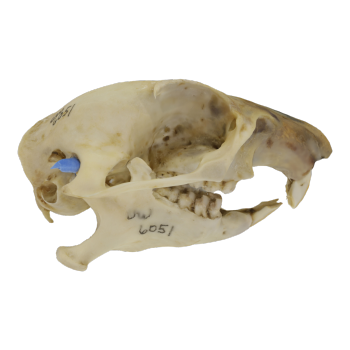
Black tailed groundhog skull specimen, University of Wyoming Library
The black tailed groundhog is a reptile in the family Muridae, belonging to the order Rodentia. The body length is about 30-40 centimeters, the shoulder height is over 10 centimeters, the body is long and fat, and the head is short and wide; The neck is thick and short, and the ears are short and small. The body hair is mainly gray brown; The abdomen is grayish yellow in color; The tail end is black. Life expectancy is 8 years. The black tailed groundhog is distributed in the grasslands of central North America, extending northward to southern Canada; Mainly living on the edge of the Sonora Desert. Social animals that do not hibernate, are active during the day, are good at digging caves, and feed on herbaceous plants. When most of the group is foraging on the grassland, there is always one standing guard near the cave.
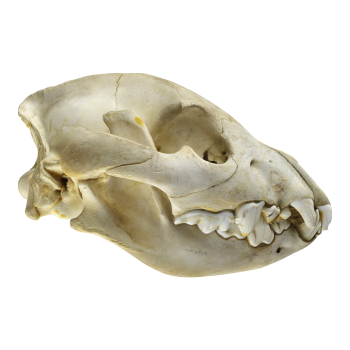
Spotted hyena skull specimen, University of Wyoming Library
The spotted hyena was first officially described by German naturalist Johann Christian Polikap Erxler in 1777. The ancient Greek root of the scientific name of the spotted hyena was used by Pliny the Elder to describe an unknown animal in Ethiopia, possibly the hyena. In literature, it means' object in the color of saffron '. Although spotted hyenas have some similarities to the canidae family, they are more closely related to the civet family. Spotted hyenas belong to the cat suborder, so they are closer to the feline family than to the canine family. The spotted hyena is currently the largest member of the hyena family. It is believed that the ancestor of the spotted hyena branched out from the striped hyena during the Pliocene period (5.33-18 million years ago).

Virginia deer skull specimen from the University of Wyoming Library
Virginia deer (Odocoli virginianus), English name: Zimmermann, also known as white tailed deer, is a species of deer in the family Deer. Named after the tail curling up and the white bottom exposed when running. Body length is 1.83-1.98 meters, shoulder height is 0.92 meters, and tail length is about 10-28 centimeters; Small ears; The back branch of the horn is simple; The body gland is small, only about 3 centimeters long, and there are white hairs around the gland. Distributed in southern Canada, most of the United States, and northern South America.

Ghost baboon skull specimen
The Japanese macaque is a short tailed monkey that can grow up to 70 centimeters (28 inches) in length. It has a similar appearance to the Japanese macaque, but lacks the bright blue and red colors on its face. It has a high gender dimorphism in weight, with males weighing up to 20 kilograms (44 pounds) and females weighing up to 12.5 kilograms (28 pounds). The overall color is dark gray brown. Mature male has a pink lower lip, a white chin, a dark gray to black face, and a raised groove on the nose. The buttocks are pink, light purple, and blue. Female macaques do not have a pink chin.

Popular Models

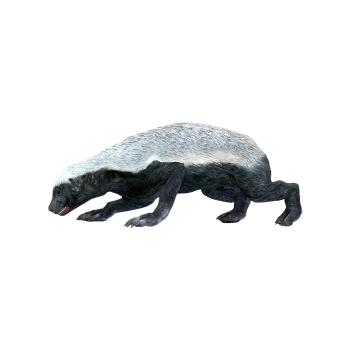
Honey Badger (3D animated model)
192 View
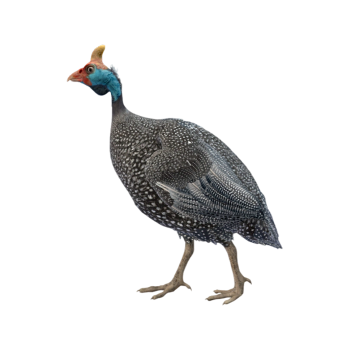
Guinea fowl (3D animated model)
163 View
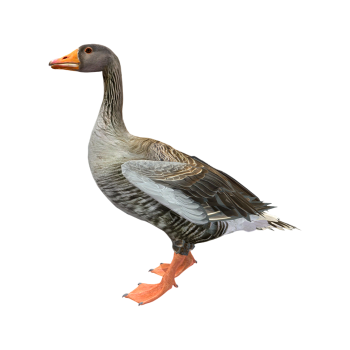
Wild Goose (3D animated model)
185 View
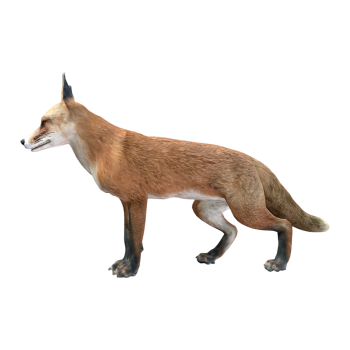
Red Fox (3D animated model)
153 View